

Vaizdas:Flag of Europe.svg

Pradinė rinkmena (SVG rinkmena, formaliai 810 × 540 taškų, rinkmenos dydis: 1 KiB)
 |
This media file has been protected from editing to prevent vandalism. Please discuss changes on the talk page or request unprotection. |
Aprašymas
| Aprašymas |
Беларуская: Сцяг Еўропы, які ўяўляе сабою 12 залатых пяціканцовых зорак, размешчаных па кругу, аналагічна лічбам на цыферблаце гадзінніка. Выкарыстоўваецца Еўрапейскім Саюзам і Саветам Еўропы.
Čeština: Vlajka Evropské unie
Deutsch: Die Europaflagge besteht aus einem Kranz aus zwölf goldenen, fünfzackigen, sich nicht berührenden Sternen auf azurblauem Hintergrund.
Sie wurde 1955 vom Europarat als dessen Flagge eingeführt und erst 1986 von der Europäischen Gemeinschaft übernommen. Die Zahl der Sterne, zwölf, ist traditionell das Symbol der Vollkommenheit, Vollständigkeit und Einheit. Nur rein zufällig stimmte sie zwischen der Adoption der Flagge durch die EG 1986 bis zur Erweiterung 1995 mit der Zahl der Mitgliedstaaten der EG überein und blieb daher auch danach unverändert.Ελληνικά: Σημαία της Ευρώπης
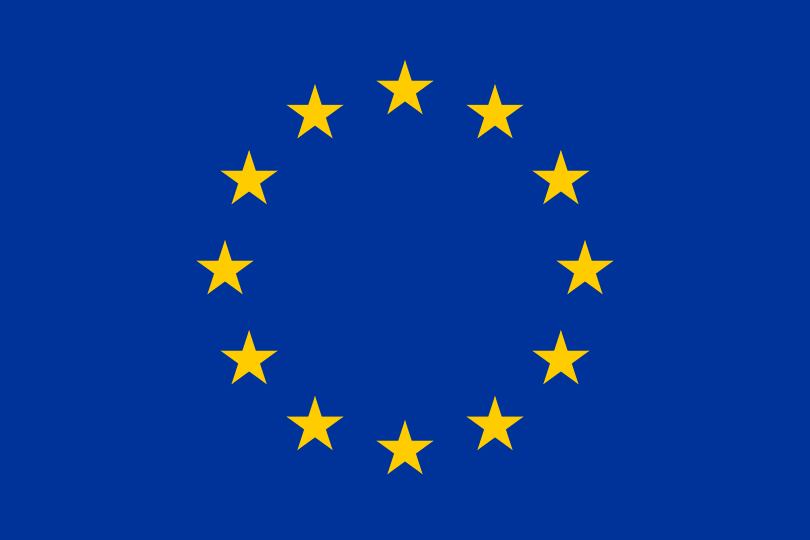
English: The Flag of Europe is the flag and emblem of the European Union (EU) and Council of Europe (CoE). It consists of a circle of 12 golden (yellow) stars on a blue background. It was created in 1955 by the CoE and adopted by the EU, then the European Communities, in the 1980s.
The CoE and EU are distinct in membership and nature. The CoE is a 47-member international organisation dealing with human rights and rule of law, while the EU is a quasi-federal union of 27 states focused on economic integration and political cooperation. Today, the flag is mostly associated with the latter. It was the intention of the CoE that the flag should come to represent Europe as a whole, and since its adoption the membership of the CoE covers nearly the entire continent. This is why the EU adopted the same flag. The flag has been used to represent Europe in sporting events and as a pro-democracy banner outside the Union.Español: La Bandera de la Unión Europea consta de doce estrellas amarillas sobre fondo azul. Inicialmente, era el símbolo utilizado por el Consejo de Europa, quien adoptó la bandera el 8 de diciembre de 1955, inspirándose probablemente en alguno de los múltiples diseños que se atribuyen a Arsène Heitz, un pintor de Estrasburgo, con el propósito manifiesto de que fuera utilizada por el mayor número de organizaciones posible, fomentando así la integración de Europa. Posteriormente, también las Comunidades Europeas adoptaron este símbolo, que hoy representa a la Unión Europea.
Esperanto: Flago de la Eŭropa Unio
Eesti: Euroopa lipp
Suomi: Euroopan lippu
Français : Le Drapeau européen est le symbole non seulement de l’Union européenne, mais aussi de l’unité et de l’identité de l’Europe dans un sens plus large, puisqu'il a d'abord été le drapeau du Conseil de l'Europe. Le cercle d'étoiles dorées représente la solidarité et l’harmonie entre les peuples d’Europe. Le nombre d'étoiles n’est pas lié au nombre d’États membres. Les créateurs du drapeau, Paul M.G Lévy et Arsène Heitz, voulaient représenter la couronne de 12 étoiles de la Vierge Marie de la rue du Bac à Paris. Ainsi, le drapeau reste le même, indépendamment des élargissements du Conseil de l'Europe (actuellement 46 membres) ou de l'Union européenne (actuellement 27 membres).
Hrvatski: Zastava Europske unije
Magyar: Az Európai Unió zászlaja
Italiano: La Bandiera dell'Europa raffigura dodici stelle dorate disposte in cerchio su campo blu. Anche se la bandiera viene comunemente associata all'Unione europea, venne inizialmente usata dal Consiglio d'Europa, ed è pensata per rappresentare l'intera Europa geografica e non una particolare organizzazione come la stessa Unione europea od il Consiglio d'Europa.
Latviešu: Eiropas Savienības karogs
Nederlands: Vlag van Europa
Polski: Flaga Unii Europejskiej
Português: Bandeira europeia
Română: Steagul Uniunii Europene
Русский: Флаг Европы содержит кольцо из двенадцати золотых(жёлтых)звёзд на синем фоне.Его обычно связывают с Европейским союзом,ранее Европейским сообществом,которое приняло этот флаг в 1980-х.Но впервые флаг был принят Советом Европы,который создал его в 1955.
Число звёзд не означает число государств-членов.Здесь двенадцать звёзд,потому что число двенадцать традиционно символ совершенства,законченности и единства.
Српски / srpski: Застава Европске уније
Slovenščina: Zastava Evropske Unije
Shqip: Flamuri i Evropës
Türkçe: Avrupa Bayrağı
Українська: Прапор Європи, який використовується Європейський Союзом та Радою Європи. Представляє собою синє полотнище з дванадцятьма золотистими зірками, які розташовані радіально навколо центра, і їх розташування таке саме як розташування цифр на годиннику. Вперше прапор був затверджений в 1955 році Радою Європи, а Європейським Союзом він був затверджений як офіційний символ вже в 1980-их роках.
中文(简体):欧盟旗帜
Detailed specifications and construction sheet (European Union website) |
| Šaltinis |
|
| Autorius | User:Verdy p, User:-xfi-, User:Paddu, User:Nightstallion, User:Funakoshi, User:Jeltz, User:Dbenbenn, User:Zscout370 |
| Leidimas (Šios rinkmenos panaudojimas kitur) |
see below |
| Kitos versijos |
|

| Flag of Europe* | |||||
|---|---|---|---|---|---|
| country | All countries of the European continent | ||||
| used by | 1) Council of Europe 2) European Union | ||||
| current since | 1) 9 december 1955 2) 1983 (European Parliament), 1986 (European Communities) | ||||
| created by | Arsène Heitz | ||||
| format | 2:3 | ||||
| shape | rectangular | ||||
| colours |
| ||||
| other characteristics | flag contains 12 stars  (special formation of the stars: five-point-stars, all upright, equally spaced on a central circle whose radius is one 3rd of the flag height (like the 12 hours on a circular clock); each star is regular and placed on a circle whose radius is one 18th of the flag height.). (special formation of the stars: five-point-stars, all upright, equally spaced on a central circle whose radius is one 3rd of the flag height (like the 12 hours on a circular clock); each star is regular and placed on a circle whose radius is one 18th of the flag height.). | ||||





Licencija
Original graphical design and permission of use
The Council of Europe holds the copyright for the European flag.
Requests shall be addressed to the Legal Affairs Directorate of the Council of Europe: [F-67075 Strasbourg Cedex; tel. +33-388 41 20 00; fax +33-388 41 20 52]
The European emblem may be used only if:
- there is no likelihood of the user of the emblem being confused with the European Community or the Council of Europe;
- the emblem is not used in connection with objectives or activities which are incompatible with the aims and principles of the European Community or of the Council of Europe.
Permission to use the European emblem does not confer on those to whom it is granted any right of exclusive use, nor does it allow them to appropriate the emblem or any similar trademark or logo, either by registration or any other means. Each case will be examined individually to ascertain whether it satisfies the criteria set out above. This will be unlikely in a commercial context if the European emblem is used in conjunction with a company's own logo, name or trade mark.
(See: Official copyright and legal statement)

|
Šiame paveikslėlyje vaizduojama vėliava, herbas, antspaudas ar kita insignija. Šių simbolių naudojimas yra ribojamas daugelyje valstybių. Šie ribojimai yra nepriklausomi nuo autorinių teisių statuso. |
For the file format and data
The following licence only covers the creation of the file, not the flag's graphical design itself.

|
Aš, šio darbo autorinių teisių savininkas, šį darbą skelbiu viešo naudojimo. Tai galioja visame pasaulyje. Kai kuriose šalyse tai negali būti legaliai leidžiama; jei taip: Suteikiu teisę naudoti šį darbą bet kokiai paskirčiai, be jokių sąlygų, nebent jos reikalaujamos įstatymų. |
Rinkmenos istorija
Paspauskite ant datos/laiko, kad pamatytumėte rinkmeną tokią, kokia ji buvo tuo metu.
| Data/Laikas | Miniatiūra | Matmenys | Naudotojas | Paaiškinimas | |
|---|---|---|---|---|---|
| dabartinis | 15:55, 21 spalio 2008 | | 810 × 540 (1 KiB) | Rjd0060 | Reverted to version as of 15:52, 21 October 2008 |
| 15:52, 21 spalio 2008 |  | 810 × 540 (1 KiB) | Silver Spoon | Reverted to version as of 23:49, 9 May 2008 | |
| 15:52, 21 spalio 2008 |  | 810 × 540 (1 KiB) | Xinese-v | Restituyendo la bandera europea | |
| 23:49, 9 gegužės 2008 |  | 810 × 540 (1 KiB) | Ssolbergj | Reverted to version as of 12:10, 24 August 2007 | |
| 23:49, 9 gegužės 2008 |  | 810 × 540 (5 KiB) | Ssolbergj | regroup stars | |
| 12:10, 24 rugpjūčio 2007 |  | 810 × 540 (1 KiB) | Ms2ger | Replace with image from Image:European flag.svg, which seems to be preferable | |
| 09:56, 24 rugpjūčio 2007 |  | 945 × 630 (1 KiB) | Ssolbergj | == Summary == {{Information |Description=The flag of The Council of Europe and The European Union |Source=self-made |Date= |Author= Ssolbergj }} == Licensing == {{PD-self}} |

Rinkmenos naudojimas
Šie puslapiai naudoja šią rinkmeną:
Visuotinis rinkmenos naudojimas
Ši rinkmena naudojama šiose viki svetainėse:
- Naudojama ab.wikipedia.org
- Naudojama ady.wikipedia.org
- Naudojama af.wikipedia.org
- Christene
- Denemarke
- Duitsland
- Estland
- Europese Unie
- Finland
- Japan
- Suid-Afrika
- Sweeds
- Swede
- Volksrepubliek China
- Spanje
- Frankryk
- Hongarye
- Verenigde State van Amerika
- Wikipedia:Uitgesoekte herdenkings/26 Mei
- Verenigde Koninkryk
- Italië
- Duits
- België
- Nederland
- Pole
- Roemeens
- Roemenië
- Kroasië
- Nederlands
- Portugal
- Grieks
- Suid-Afrikaanse rand
- Kanada
- Australië
- Engels
- Maltees
- Nobelprys vir Vrede
- Wikipedia:Uitgesoekte herdenkings/Mei
- Frans
- Letland
- Geldeenheid
- Litaue
- Republiek Ierland
- Indië
- Jean-Claude Juncker
- Rusland
- Euro
- Lets
- Litaus
- Esties
Žiūrėti visuotinį šios rinkmenos naudojimą.

